Questions hidden inside
- Where is a book's identity located: in one physical copy, the words, the arrangement, or the work readers encounter?
- How much authority should an author's intention have over later interpretations?
- Can a reader misunderstand a book while still discovering something valuable through it?
- What is lost when a damaged or annotated copy is replaced by a clean edition?
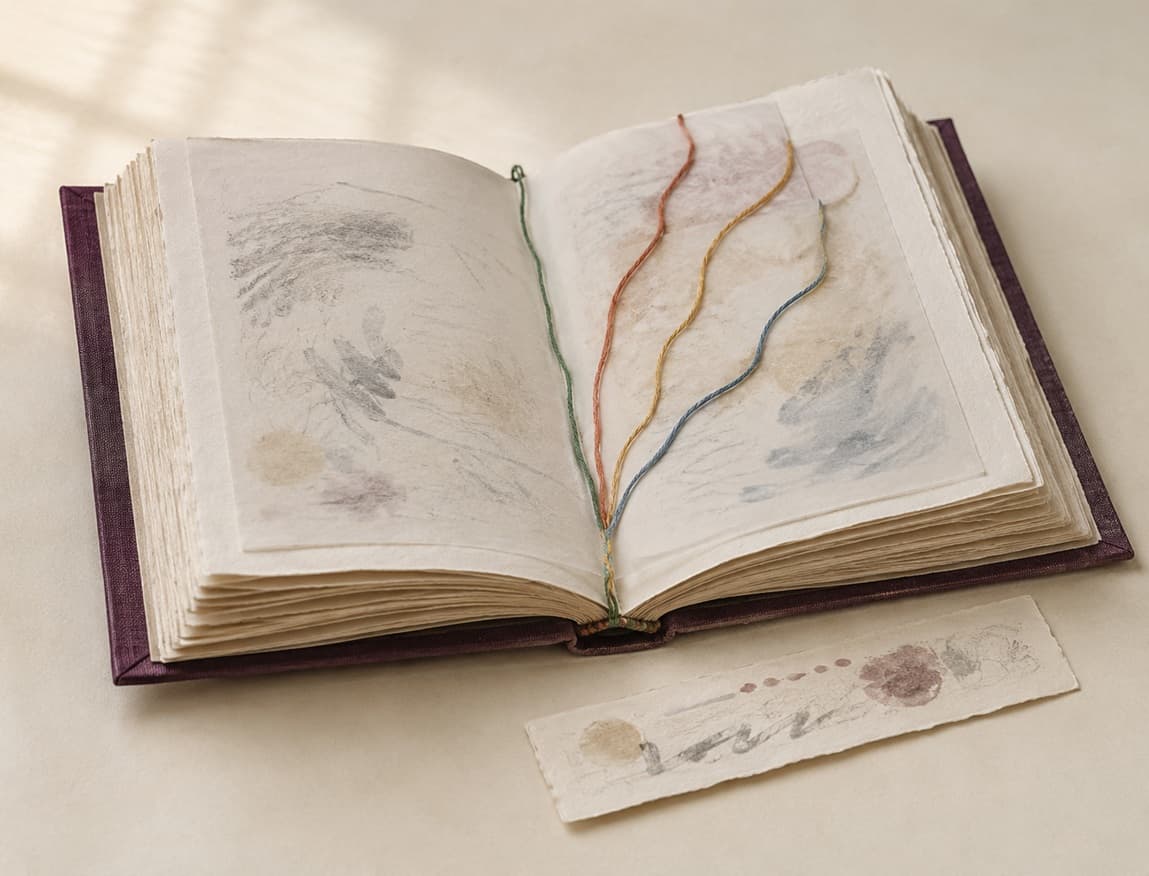
Philosophical lenses
Interpretation
How does a text acquire meaning?
Meaning emerges through language, structure, context, tradition, and readers, but interpretive openness does not make every reading equally well supported.
Identity
What makes different copies instances of the same book?
A work can survive replacement of paper, binding, typography, or medium, while some editions and annotations become historically distinct objects.
Value
Why can one copy matter more than another?
Informational, aesthetic, historical, personal, and market value can attach to different features of a book and need not coincide.
One word for an object and a work
The word book can name a particular physical copy, a sequence of words and images, an edition, or a larger intellectual work. A paperback and an electronic file may present substantially the same text while remaining different objects with different histories.
This distinction explains why destroying one copy does not ordinarily destroy the book as a work. It also explains why a first edition, an author's copy, or a heavily annotated volume can be irreplaceable even when the words are available elsewhere.
The same text can be widely reproducible while a particular copy remains historically or personally unique.
Reading is guided but not mechanical
Words and structures constrain interpretation, yet readers approach them with different questions, histories, knowledge, and expectations. Understanding often moves between individual passages and a developing sense of the whole, with each revising the other.
An author's intention can provide important evidence, but it may not settle every meaning a work can reasonably sustain. Later readers may notice implications, tensions, or social assumptions that the author did not explicitly identify.
| Source of interpretive guidance | What it contributes | What it cannot settle alone |
|---|---|---|
| Words and structure | Publicly available patterns and claims | Every implication or application |
| Authorial intention | Purpose, context, and intended use | All later meanings or effects |
| Historical context | Conventions and disputes surrounding the work | What the text should mean now |
| Reader response | Lived significance and newly noticed connections | Whether the interpretation is textually defensible |
Owning a copy is not owning its meaning
A person may own a physical book and decide whether to lend, sell, mark, repair, or discard that copy. Ownership does not normally grant control over every interpretation, quotation, criticism, or memory other readers form from the work.
Libraries, classrooms, publishers, and digital platforms add further layers of access. Decisions about preservation, lending, pricing, and format shape who can encounter a work, even when they do not alter the text itself.
When reading becomes part of the object
Annotations, folded pages, stains, repairs, and inscriptions can record a history of use. They may interfere with another reader's experience while also showing how earlier readers questioned, valued, or lived with the book.
Replacing a marked copy with a clean edition can improve legibility and preserve the work's text, yet it may remove evidence of a relationship. Whether replacement is a gain or loss depends on which continuity matters in the decision.
- Distinguish preserving the text from preserving a particular copy.
- Ask whether annotations are damage, interpretation, historical evidence, or several of these at once.
- Evaluate interpretations through reasons and textual support rather than through personal response alone.
A short reasoning exercise
Change one fact. See what carries the weight.
A changed detail can reveal which principle or consequence matters most to your judgment. Compare the two situations, choose a response, and receive a brief interpretation. There is no score or single correct answer.
1. Starting position
Your initial judgment: Replace a heavily annotated family book with a clean modern edition.
2. Change only this fact
You learn that the annotations were made by several relatives over decades and are the only surviving record of their responses to the text.
3. Would this change which copy you preserve or how you use each one?
Choose the response closest to your present view. You can try another answer afterward.
Continue with Ada

Professor Ada Rowan
Test an idea or objection
Compare perspectives, test an assumption, or develop an objection using this reviewed page as context.
Related paths
Sources
- Hermeneutics (2025)
Scholarly overview of interpretation, understanding, language, history, art, literature, and the hermeneutical circle. It shows how meaning emerges through relations among text, context, author, reader, tradition, and the limits of understanding.
View source - Aesthetics of the Everyday (2025)
Scholarly overview of aesthetic attention, ordinary objects, environments, routines, use, familiarity, and the boundary between art and everyday life. It explains how familiar things can carry philosophical significance without making every preference a moral judgment.
View source - Intrinsic vs. Extrinsic Value — Michael J. Zimmerman; Ben Bradley (2025)
Scholarly overview of distinctions among intrinsic, extrinsic, final, and instrumental value. It is useful for clarifying whether something matters in itself, as a means, because of its relations, or under particular conditions.
View source - Identity Over Time — Andre Gallois; Irem Kurtsal (2026)
Scholarly treatment of persistence, change, material constitution, temporal parts, and competing responses to the Ship of Theseus, providing conceptual tools for distinguishing strict identity from looser continuities.
View source
Last modified 2026-07-30. Reviewed by Thinking Paths editorial team.