Questions hidden inside
- Does a car increase autonomy when communities are designed so that daily life is difficult without one?
- How should drivers, manufacturers, planners, and institutions share responsibility for systemic harms?
- When does personal convenience justify imposing risk, noise, pollution, or lost public space on others?
- Why can a car function as transportation, property, status symbol, shelter, and identity marker at once?
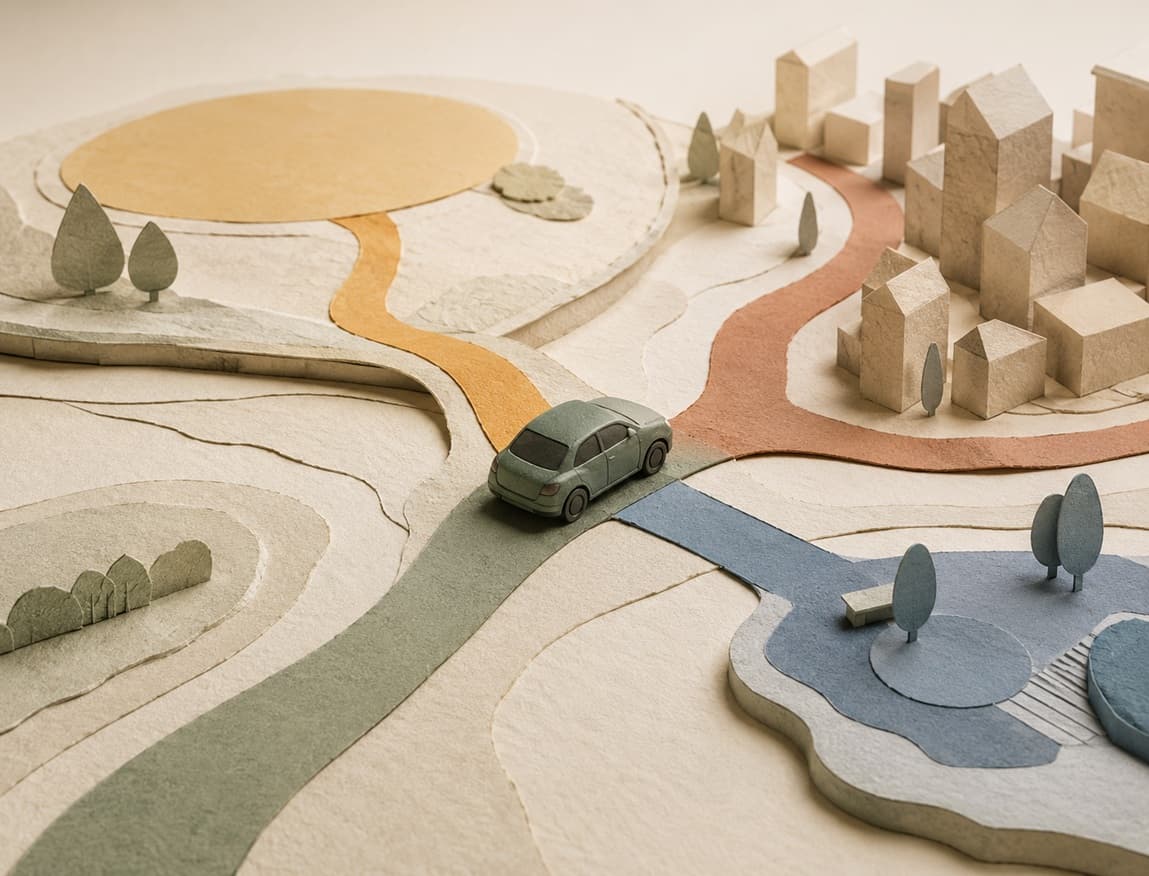
Philosophical lenses
Autonomy
Which movements become realistically possible?
A car can widen access to work, care, community, and privacy while also becoming compulsory where alternatives are absent.
Risk
Who creates, controls, and bears danger?
Driving distributes risk among occupants, pedestrians, cyclists, nearby residents, and future people, often under unequal conditions.
Infrastructure
How does the system shape the individual choice?
Roads, parking, zoning, fuel, finance, enforcement, and public transit make some travel choices easy and others costly or unavailable.
Freedom of movement within a designed system
A car can provide control over route, timing, passengers, climate, and carried belongings. For many people it enables access to employment, medical care, family, education, or places that other transportation does not reach.
That freedom can coexist with structural dependence. When homes, jobs, shops, and services are separated by road networks with few alternatives, owning or accessing a car becomes less a free preference than a condition of participation.
A tool can increase individual freedom while the larger system reduces the freedom to live without it.
A private object using shared space
Cars are privately used but depend on extensive public and collective arrangements. Roads, parking, traffic control, emergency response, land allocation, and environmental regulation support each trip and shape the lives of people who are not traveling by car.
Allocating street space is therefore not merely a technical choice. Giving more room to moving and stored vehicles can improve some journeys while reducing space for housing, trees, walking, cycling, play, or public gathering.
| Scale | Relevant choice | Responsibility question |
|---|---|---|
| Driver | Speed, attention, maintenance, and route | What risks were reasonably controllable? |
| Manufacturer | Vehicle design, safety, repairability, and marketing | Which hazards could be reduced at the source? |
| City or region | Roads, transit, zoning, and enforcement | Which forms of mobility receive support? |
| Shared system | Energy use, emissions, and long-term land patterns | How should cumulative harms be divided and repaired? |
Ordinary action with serious risk
Driving is familiar enough to feel routine, but it involves speed, mass, limited visibility, and dependence on the coordinated behavior of strangers. Responsibility includes attention, competence, maintenance, and adjustment to conditions rather than an intention merely to reach a destination.
Actual outcomes are also shaped by luck and design. A careless act may cause no injury, while a small error can become catastrophic because of road geometry, vehicle design, or another person's position. Individual accountability and system improvement can therefore be necessary together.
Transportation that also signifies
A car can signal status, practicality, taste, occupation, environmental concern, family role, or belonging. Those meanings influence purchasing and policy, but they are unstable and should not be used to infer a driver's character or identity with confidence.
For some people a car is also a workplace, storage space, refuge, or temporary shelter. Moral evaluation should attend to these different uses rather than assume every driver has the same alternatives, resources, or reasons.
- Distinguish personal driving choices from infrastructure that constrains the available options.
- Compare risks and benefits across drivers, passengers, non-drivers, and future residents.
- Avoid treating a vehicle's market category as proof of the owner's moral character.
A short reasoning exercise
Change one fact. See what carries the weight.
A changed detail can reveal which principle or consequence matters most to your judgment. Compare the two situations, choose a response, and receive a brief interpretation. There is no score or single correct answer.
1. Starting position
Your initial judgment: Drive alone because it is the fastest and most reliable option.
2. Change only this fact
A new public route reaches the same destination with slightly more travel time but substantially lower shared cost and risk.
3. Would the availability of a workable alternative change what convenience justifies?
Choose the response closest to your present view. You can try another answer afterward.
Continue with Ada

Professor Ada Rowan
Test an idea or objection
Compare perspectives, test an assumption, or develop an objection using this reviewed page as context.
Related paths
Sources
- Installing Automobility: Emerging Politics of Mobility and Streets in Indian Cities — Govind Gopakumar (2020)
Gopakumar studies how automobility is built through infrastructure, planning, politics, and contested urban space rather than arising from individual car choices alone. The analysis shows how vehicles, roads, institutions, and social priorities shape one another.
View source - Risk (2022)
Philosophical overview of risk, uncertainty, probability, precaution, consent, distribution, responsibility, and ethical decision-making when outcomes are unknown. It provides shared vocabulary for unintended consequences, technology, environmental stewardship, and future generations.
View source - Collective Responsibility — Marion Smiley (2022)
Scholarly overview of responsibility attributed to groups, institutions, and collections of individuals, including group agency, shared responsibility, blame distribution, forward-looking duties, and remedial obligations.
View source - Moral Responsibility — Matthew Talbert (2024)
Authoritative overview of the capacities, control, knowledge, answerability, and accountability conditions involved in moral responsibility, including the distinction between causal responsibility and blameworthiness.
View source - Autonomy in Moral and Political Philosophy — John Christman (2025)
Scholarly overview of autonomy as self-government, authenticity, and independence from manipulative or distorting forces, with distinctions among personal, moral, basic, ideal, and relational autonomy.
View source
Last modified 2026-07-30. Reviewed by Thinking Paths editorial team.