Questions hidden inside
- What can a mirror reveal about a person, and what must remain beyond its surface?
- Do we look in a mirror to see ourselves or to imagine how others will see us?
- Can changing an appearance express authenticity as readily as preserving one?
- Why can a familiar reflection sometimes seem unfamiliar without making the person someone else?
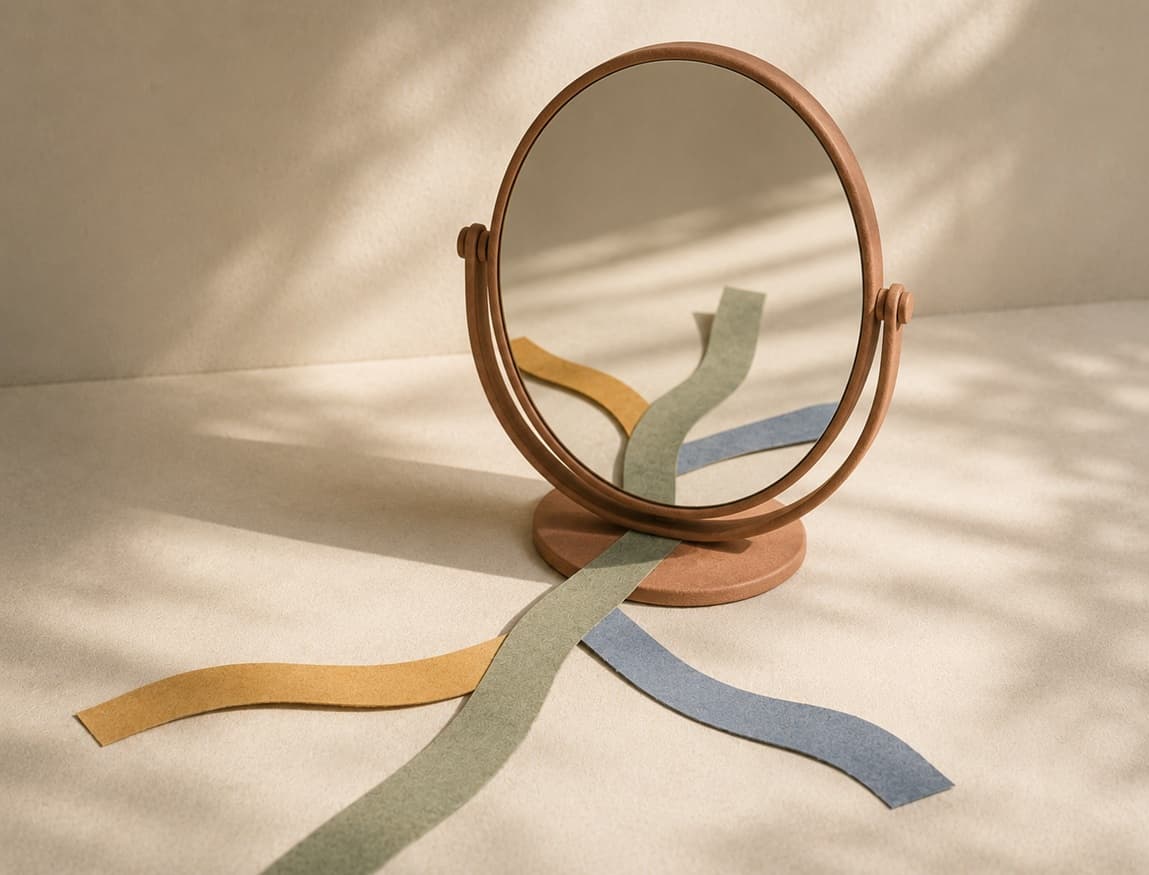
Philosophical lenses
Self-knowledge
What can appearance tell us about ourselves?
A mirror provides visual information, but beliefs, motives, character, and identity require interpretation that no reflected surface can complete.
Authenticity
Does the reflection express a self or perform a role?
Appearance can be chosen, inherited, constrained, experimental, or audience-directed, so authenticity cannot be read directly from style.
Recognition
Whose perspective enters the reflection?
People often view themselves through social categories and anticipated judgments, making the mirror part physical object and part imagined audience.
A reliable surface with limited information
A well-made mirror reflects light in a regular way, allowing a person to inspect visible features from a particular angle and moment. It can answer practical questions about clothing, injury, expression, or whether something has changed.
The apparent directness can encourage a larger conclusion: that seeing one's surface is seeing oneself. Yet the mirror does not display memory, intention, relationships, commitments, or how a person acts when no reflection is present.
The image may be immediate without being a complete account of the person.
Looking at oneself as another might
A mirror lets a person occupy two positions at once: the embodied person who is looking and the visible figure being inspected. This can make it useful for self-presentation, but it can also introduce an imagined audience into a private moment.
The standards applied to the reflection may come from personal aims, practical roles, cultural expectations, or anticipated judgments. Noticing those influences does not show that the resulting choice is false or imposed; it identifies the social setting in which self-presentation occurs.
| Use of the mirror | Question being asked | What the reflection cannot decide |
|---|---|---|
| Practical inspection | What do I look like now? | Whether the appearance is morally or personally good |
| Preparation for an audience | How am I likely to be seen? | Whether the audience's standard deserves authority |
| Identity reflection | Does this still look like me? | What makes the person persist through change |
| Creative experimentation | Could I present myself differently? | Which presentation is uniquely authentic |
Authenticity is not visual consistency
A person may change clothing, hairstyle, posture, or expression to fit a role, resist a role, explore a possibility, or communicate membership. The same outward change can have very different meanings because authenticity concerns how a choice relates to the person's reasons and circumstances.
Keeping the same appearance is not automatically authentic, and changing it is not automatically artificial. Social influence is unavoidable; the deeper question is whether a person can understand, question, and revise the influences shaping the presentation.
A changing image of a continuing person
Mirrors make gradual change visible only in the present. Photographs and memory supply comparisons, while other people contribute recognition and stories. Together they can make aging or transformation feel continuous, abrupt, welcome, or disorienting.
Personal identity is not settled by resemblance. A person can remain the same individual through major visible change, while two people who look alike remain distinct. The mirror raises the question of continuity without providing the criterion that resolves it.
- Distinguish visual resemblance from personal identity.
- Ask which audience or standard is being imagined.
- Treat appearance as meaningful without inferring moral character or a fixed inner type.
A short reasoning exercise
Change one fact. See what carries the weight.
A changed detail can reveal which principle or consequence matters most to your judgment. Compare the two situations, choose a response, and receive a brief interpretation. There is no score or single correct answer.
1. Starting position
Your initial judgment: Change your appearance because the reflection seems noticeably wrong.
2. Change only this fact
You learn that the mirror is subtly warped and the lighting is unusually harsh.
3. Would this change how much authority you give the reflected image?
Choose the response closest to your present view. You can try another answer afterward.
Continue with Ada

Professor Ada Rowan
Test an idea or objection
Compare perspectives, test an assumption, or develop an objection using this reviewed page as context.
Related paths
Sources
- Self-Knowledge (2021)
Survey of knowledge of one’s own beliefs, desires, sensations, character, and agency, including first-person authority, introspection, transparency, interpretation, and error. It challenges the assumption that self-observation is simple or infallible.
View source - Authenticity (2020)
Scholarly account of authenticity in existential, moral, social, and political thought, including self-creation, social influence, sincerity, conformity, and critiques of an isolated inner true self. It supports discussions of mirrors, clothing, identity, and digitally mediated self-presentation.
View source - Personal Identity — Eric T. Olson (2023)
Scholarly overview of distinct personal-identity questions, including characterization, personhood, persistence, evidence, psychological-continuity accounts, animalism, bodily continuity, fission, and the practical importance of survival.
View source - Autonomy in Moral and Political Philosophy — John Christman (2025)
Scholarly overview of autonomy as self-government, authenticity, and independence from manipulative or distorting forces, with distinctions among personal, moral, basic, ideal, and relational autonomy.
View source
Last modified 2026-07-30. Reviewed by Thinking Paths editorial team.