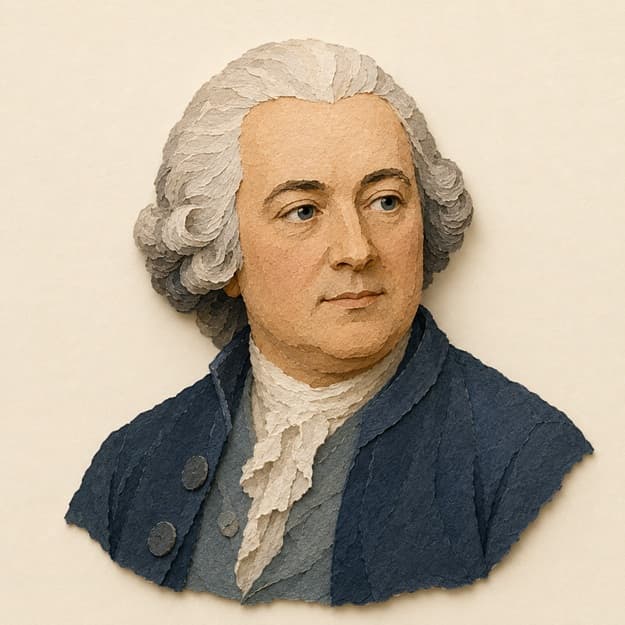
Questions hidden inside
- What justifies our expectation that the future will resemble the past?
- Do we experience a continuing self or only changing perceptions?
- What roles do reason and passion play in action and moral judgment?
- How far does Hume's skepticism undermine ordinary knowledge and responsibility?
An experimental approach to human nature
David Hume lived from 1711 to 1776 and wrote on human understanding, passions, morals, religion, politics, economics, and history. His early Treatise sought a systematic study of human nature grounded in experience and observation.
Hume's arguments are often skeptical, but they do not simply recommend abandoning ordinary belief. He repeatedly examines how habits, sentiments, and shared practices continue to guide life even when reason cannot provide the kind of proof philosophers sometimes demand.
Experience, habit, and causal expectation
Hume distinguishes impressions, which are comparatively vivid experiences, from ideas, which are less vivid representations in thought. He uses this framework to ask where meaningful ideas come from and whether philosophical claims can be traced to experience.
In causation, repeated observation reveals regular succession but not a directly perceived necessary connection. Expectation is formed through custom or habit, which explains how people reason from past experience without providing a non-circular proof that nature must remain uniform.
The self as a difficult problem
When Hume looks inward, he reports encountering particular perceptions rather than a simple, unchanging self. This supports interpretations often called bundle theories, in which the mind is understood through related perceptions rather than an independently perceived substance.
Memory and causal relations help organize perceptions into a continuing life, but Hume later acknowledged unresolved difficulty in the Treatise's Appendix. His position should therefore not be presented as a simple proof that the self does not exist.
| Theme | Humean question | Continuing dispute |
|---|---|---|
| Causation | What is experienced beyond regular succession? | Whether Hume offers skepticism, a psychological account, or both |
| Personal identity | What unifies changing perceptions? | How memory and causal relations can supply unity without circularity |
| Agency | How do passions and reasons move action? | How to interpret Hume's claims about reason and motivation |
| Morality | How do sentiment and reflection support evaluation? | Whether Hume's ethics is best classified as sentimentalist, naturalist, or something more complex |
Moral sentiment without mere preference
Hume gives feeling an important role in moral approval and disapproval, but this does not reduce morality to any individual's passing reaction. General points of view, sympathy, social usefulness, character, and correction of partial perspectives contribute to moral judgment.
Scholars continue to debate the unity and development of Hume's project, the strength of his skepticism, and the relation among reason, passion, convention, and virtue. His philosophy resists reduction to the claim that reason never matters or that the self is merely unreal.
- Distinguish a psychological explanation of belief from a justification of the belief.
- Treat the bundle description as part of an unresolved debate about personal identity.
- Avoid reducing moral sentiment to arbitrary individual taste.
- Use Hume's skeptical arguments to clarify standards of evidence rather than to declare all knowledge impossible.
Continue with Ada

Professor Ada Rowan
Test an idea or objection
Compare perspectives, test an assumption, or develop an objection using this reviewed page as context.
Related paths
Paths through the present
Recent reflections featuring this philosopher
Sources
- A Treatise of Human Nature — David Hume (1896)
Primary source for Hume’s account of the mind as a succession or bundle of perceptions, his discussion of memory and causal relations in personal identity, and his later admission in the Appendix that he could not fully reconcile his account.
View source - David Hume — Hsueh Qu; Elizabeth S. Radcliffe (2026)
Current scholarly overview of Hume’s philosophy, useful for placing his account of personal identity within his broader theory of perceptions, causation, passions, agency, and moral evaluation.
View source
Last modified 2026-07-30. Reviewed by Thinking Paths editorial team.