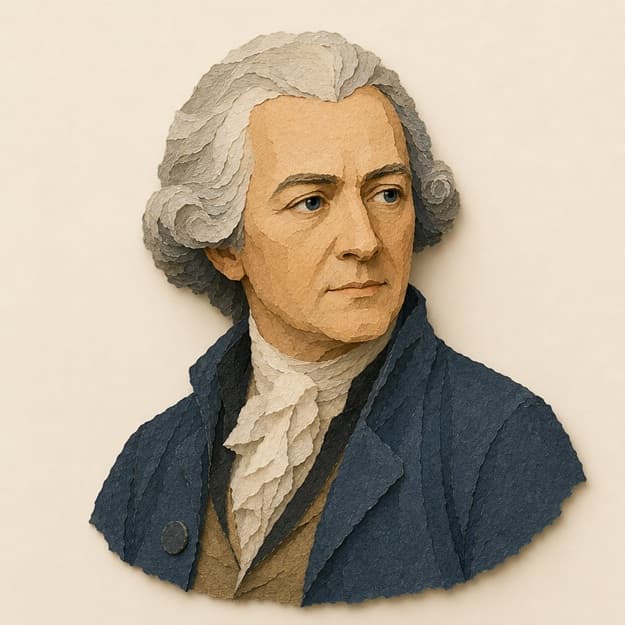
Questions hidden inside
- What gives an action moral worth: its result, its motive, or the principle on which it is chosen?
- What does it mean to act on a principle that could serve as a universal law?
- How does autonomy differ from simply doing whatever one desires?
- Why does Kant defend such demanding duties of truthfulness?
A systematic philosophy of freedom and obligation
Immanuel Kant lived from 1724 to 1804 and developed influential work on knowledge, metaphysics, ethics, aesthetics, religion, law, and political philosophy. This profile focuses selectively on the practical philosophy most directly connected with everyday moral questions.
Kant's technical vocabulary can make his ethics appear like a collection of rigid rules. His central concern is broader: how rational beings can act freely under principles they can regard as laws for themselves and for others.
Good will, duty, and moral worth
Kant argues that a good will is valuable not because it reliably produces desired outcomes but because of the principle from which it acts. An action can conform to duty for many motives, while action from duty has a distinctive form of moral worth.
This does not mean that consequences are irrelevant to every practical decision. Agents need empirical knowledge to know what their actions will do. Kant's point is that successful results alone cannot establish a morally worthy principle or justify using another person merely as a tool.
Kant distinguishes motive, intention, maxim, conformity with duty, and consequence; these should not be collapsed into one idea.
Universal law and humanity as an end
The categorical imperative is presented through several formulations. One asks whether a maxim could be willed as a universal law. Another requires treating humanity, in oneself and others, always as an end and never merely as a means.
Interpreters debate how the formulations relate, how maxims should be described, and what universalization tests establish. Respecting persons also requires more than avoiding direct coercion; deception can interfere with another person's ability to choose on the basis of reality.
| Idea | Central concern | Common oversimplification |
|---|---|---|
| Good will | The quality of practical commitment | Good intentions excuse every careless result |
| Universal law | Whether one's principle can be shared consistently | Whatever most people happen to approve |
| Humanity as an end | Respect for rational agency and dignity | Never asking anyone to serve another person's purposes |
| Autonomy | Self-legislation through rational moral principles | Acting without limits or external influence |
Truthfulness and difficult cases
Kant's rejection of a supposed right to lie is among his most disputed positions. The argument connects truthfulness with public right and warns against making private exceptions whose broader principle could not be justified.
Critics argue that threatening or unjust questioners can lose claims to truthful cooperation and that a stringent duty may expose innocent people to avoidable harm. The controversy should be presented as a demanding test of Kant's framework rather than as a settled summary of all duty-based ethics.
- Do not equate Kantian ethics with ignoring every consequence.
- Distinguish using a person as a means from using them merely as a means.
- Explain autonomy as rational self-government rather than unrestricted choice.
- Present the lying controversy with its major objections and unresolved interpretive questions.
Continue with Ada

Professor Ada Rowan
Test an idea or objection
Compare perspectives, test an assumption, or develop an objection using this reviewed page as context.
Related paths
Paths through the present
Recent reflections featuring this philosopher
Sources
- Kant: Groundwork of the Metaphysics of Morals — Immanuel Kant (1998)
Primary source for Kant's claims that a good will is not valuable because of what it achieves, that duty is governed by the categorical imperative, and that persons must be treated as ends rather than merely as means.
View source - On a Supposed Right to Lie from Philanthropy (1797) — Immanuel Kant (1996)
Primary text for Kant's stringent rejection of a supposed right to lie, including his account of public right, responsibility for consequences, and the controversy commonly illustrated by a threatening questioner.
View source - Deontological Ethics — Larry Alexander; Michael Moore (2024)
Authoritative overview of duty-based theories that assess choices through constraints, permissions, obligations, agency, rights, and the distinction between intending harm and merely allowing or foreseeing it.
View source
Last modified 2026-07-30. Reviewed by Thinking Paths editorial team.