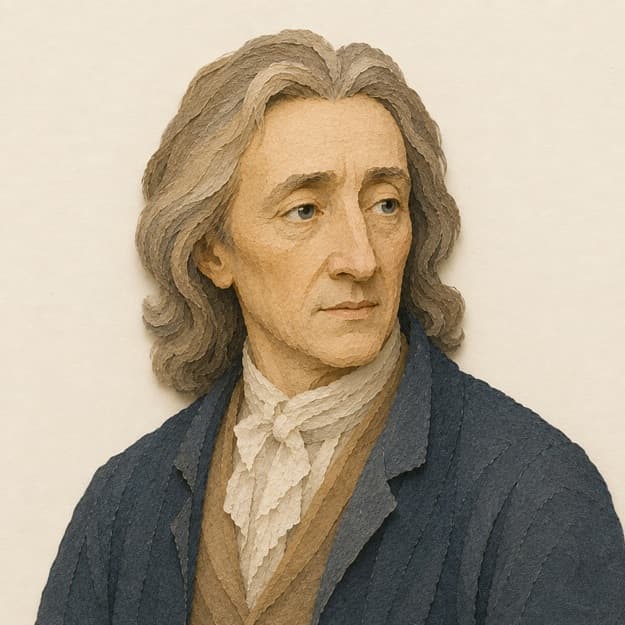
Questions hidden inside
- How do experience and reflection contribute to human knowledge?
- Why does Locke distinguish the identity of a person from the identity of a body or substance?
- How are natural rights, property, labor, and political authority connected in Locke's argument?
- What can consent justify, and why is tacit consent especially difficult to establish?
Knowledge, persons, and political authority
John Locke lived from 1632 to 1704 and wrote about knowledge, language, education, religion, medicine, economics, and government. His best-known works include An Essay Concerning Human Understanding, Two Treatises of Government, and A Letter Concerning Toleration.
These projects share an interest in the grounds and limits of authority. Locke asks what experience can justify, what makes someone accountable as the same person, and when political power can rightfully bind people who are naturally free and equal. His answers were historically influential, but their interpretation and application remain disputed.
Experience and the limits of understanding
Locke argues against innate speculative and practical principles, holding that the materials of thought arise through sensation and reflection on the mind's own operations. The mind combines, compares, and abstracts from these materials, so his account is not the claim that people passively copy an already organized world.
Knowledge, on Locke's account, has limits. People often must rely on probability, testimony, and judgment when demonstrative certainty is unavailable. That fallibility makes careful inquiry important and also places pressure on claims to impose contested beliefs through intellectual, religious, or political authority.
For Locke, deriving ideas from experience does not mean that every belief is equally justified or that the mind contributes nothing to thought.
Consciousness and the forensic person
Locke distinguishes the identity of a human organism, a thinking substance, and a person. A person is a being capable of reason and reflection that can consider itself as itself across different times. He connects personal identity with consciousness extending to past actions and calls person a forensic notion because praise, blame, reward, and punishment attach to persons.
This view is often shortened to a memory theory, but that label can obscure the argument. Memory is important evidence and a way consciousness reaches past experience, yet scholars disagree about whether Locke identifies consciousness with memory or offers a broader account. Objections about circularity, forgotten actions, transferred consciousness, and responsibility show why the interpretation remains unsettled.
| Topic | Locke's distinction | Common overstatement |
|---|---|---|
| Ideas | Their materials arise through sensation and reflection | The mind only receives passive copies |
| Human organism | Persists through the organization and continuation of one life | Is automatically identical with the person in every case |
| Person | Extends through consciousness and carries forensic accountability | Is defined by one isolated remembered image |
| Personal identity | Must be distinguished from sameness of material or immaterial substance | Is simply whatever someone sincerely claims |
Rights, property, and consent
In the Second Treatise, Locke presents people as naturally free and equal under a law of nature, with rights that political institutions are meant to secure. He connects property with labor applied to resources held in common, while also discussing limits involving waste, sufficiency for others, and the effects of money and agreement. The argument has generated enduring disputes about appropriation and inequality.
Legitimate government depends on consent and exists for public ends rather than a ruler's private advantage. Yet the theory faces a practical problem: most people never give explicit consent to the government under which they live. Locke's appeal to tacit consent is therefore one of the most contested parts of his political philosophy.
Toleration, influence, and historical limits
Locke opposed using coercion simply to produce religious belief and defended a significant division between civil authority and religious association. His toleration was not universal, however, and modern readers should distinguish the philosophical case against coercion from the exclusions and assumptions of his historical proposals.
Locke's language of rights, consent, property, and resistance influenced later constitutional and political argument. It has also been examined alongside colonial appropriation, unequal citizenship, and the distance between claims of natural equality and actual institutions. Reading Locke critically means taking both the arguments and those tensions seriously.
- Distinguish experience as the source of ideas from a denial of active mental operations.
- Avoid reducing personal identity to a simple memory slogan.
- Separate the identity of a person, organism, and substance.
- Examine the limits and contested applications of labor-based property.
- Ask what evidence could turn nominal or tacit acceptance into meaningful consent.
Continue with Ada

Professor Ada Rowan
Test an idea or objection
Compare perspectives, test an assumption, or develop an objection using this reviewed page as context.
Related paths
Paths through the present
Recent reflections featuring this philosopher
From the same publisher
Further exploration
Continue with another AI Sure Tech project.
Gov Studies
Trace how rights, consent, and limited government develop within liberalism (opens in a new tab)An external overview of a political tradition influenced by Locke; it is not a primary Locke source.
Sources
- An Essay Concerning Human Understanding — John Locke (1975)
Primary source for Book II, chapter XXVII, where Locke distinguishes the identity of persons from the identity of substances, links personal identity to consciousness across time, and treats person as a forensic term connected with action and accountability.
- Locke on Personal Identity — Jessica Gordon-Roth (2025)
Specialist overview of Locke’s account of persons, consciousness, memory, persistence, agency, and forensic responsibility, including major interpretive disputes and the influence of Locke’s thought experiments.
View source - Locke: Two Treatises of Government — John Locke (1988)
A scholarly edition of Locke's two political treatises, including the Second Treatise arguments about natural freedom and equality, property, consent, legislative authority, the ends of government, and resistance. The edition preserves the historical and theological setting of Locke's claims.
View source - Locke's Political Philosophy (2020)
A specialist overview of natural law and rights, the state of nature, property, consent, political obligation, punishment, institutional powers, resistance, toleration, and education in Locke's political philosophy. It documents major interpretive disagreements rather than presenting one uncontested Lockean system.
View source - Property and Ownership (2026)
Survey of property, possession, ownership, exclusion, use, transfer, justification, and the social rules that define control over things. It clarifies how a small physical object can embody permission, access, trust, and contested authority.
View source
Last modified 2026-07-31. Reviewed by Thinking Paths editorial team.