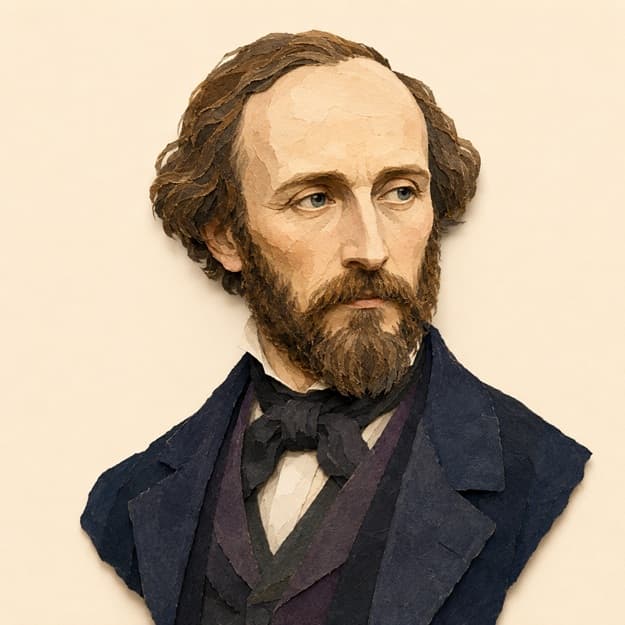
Questions hidden inside
- When may society interfere with an individual's conduct?
- Why might individuality and experiments in living contribute to general well-being?
- How does Mill's utilitarianism compare the quality as well as the quantity of pleasures?
- How do liberty, justice, equality, and social reform fit within one philosophy?
A reforming philosophy of individual and social life
John Stuart Mill lived from 1806 to 1873 and wrote on logic, political economy, representative government, liberty, ethics, religion, and equality. His positions developed over time and should not be inferred from one famous principle alone.
Mill was concerned both with the power of law and with social pressure produced through custom and public opinion. A society can leave conduct formally legal while making individuality costly through ridicule, exclusion, or expectations that go largely unquestioned.
Liberty, individuality, and the harm principle
On Liberty defends freedom of thought, discussion, association, and experiments in living. Mill argues that fallible societies benefit when beliefs can be challenged and when individuals can develop different ways of life.
The harm principle is often summarized as permitting interference only to prevent harm to others. Its application remains disputed because harm, offense, risk, dependency, public obligation, and self-regarding conduct are difficult to separate in practice.
Mill's defense of liberty addresses social conformity as well as legal prohibition.
Utility beyond immediate calculation
Mill's utilitarianism evaluates conduct and institutions through happiness and the reduction of suffering. He distinguishes higher and lower pleasures and discusses character, rules, sanctions, justice, and rights rather than treating morality as a count of immediate sensations.
Interpreters disagree about how Mill's defense of liberty fits with utilitarianism. One approach treats liberty and individuality as especially important means to long-term well-being; another asks whether utility could still justify exceptions that threaten the security of individual rights.
| Theme | Mill's concern | Continuing debate |
|---|---|---|
| Liberty | Protection of thought, action, and individuality | How harm and legitimate interference should be defined |
| Utility | Well-being considered impartially | Whether qualitative distinctions fit a single maximizing standard |
| Justice | Security, rights, and powerful moral sentiments | Whether rights remain ultimately dependent on utility |
| Equality | Removal of inherited social subordination | How fully Mill escapes assumptions of nineteenth-century liberalism |
A philosophy of progress with contested limits
Mill's arguments support open discussion, education, women's equality, institutional reform, and resistance to the tyranny of opinion. They also emerge from a nineteenth-century liberal setting whose exclusions and assumptions require critical examination.
Contemporary applications to digital platforms, attention design, public health, and misinformation are interpretations rather than positions Mill directly addressed. His work remains useful when those applications preserve the tension among freedom, evidence, harm, power, and long-term consequences.
- Do not reduce the harm principle to a complete algorithm for policy.
- Distinguish immediate outcomes from rules and institutions that shape long-term well-being.
- Treat individuality as socially valuable without assuming every choice is harmless.
- Identify contemporary applications as extensions rather than historical claims about Mill.
Continue with Ada

Professor Ada Rowan
Test an idea or objection
Compare perspectives, test an assumption, or develop an objection using this reviewed page as context.
Related paths
Paths through the present
Recent reflections featuring this philosopher
From the same publisher
Further exploration
Continue with another AI Sure Tech project.
Free Speech Atlas
Explore how political speech is treated in U.S. law (opens in a new tab)A U.S.-focused legal extension to philosophical questions about liberty, speech, and harm.
Sources
- On Liberty and The Subjection of Women — John Stuart Mill (1879)
Primary source for Mill’s defense of individuality, freedom of thought and action, limits on social authority, and concern about social pressure, providing a historical foundation for discussions of autonomy and agency in digitally mediated life.
View source - Utilitarianism — John Stuart Mill (2014)
Classic primary text for evaluating conduct through happiness and consequences, while also addressing qualitative differences in pleasures, sanctions, justice, rights, and objections to utilitarian moral reasoning.
View source - Consequentialism — Walter Sinnott-Armstrong (2023)
Scholarly survey of consequentialist theories and their variations, including what consequences count, whose good matters, actual versus expected results, act and rule approaches, and major objections involving rights, justice, and demandingness.
View source
Last modified 2026-07-30. Reviewed by Thinking Paths editorial team.