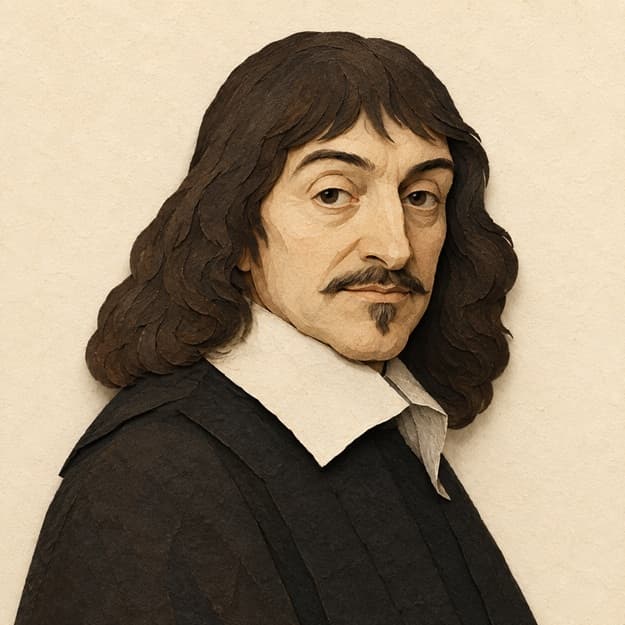
Questions hidden inside
- Why does Descartes deliberately doubt beliefs that ordinarily seem reasonable?
- What does the cogito establish, and what does it leave unresolved?
- How does Descartes distinguish thinking mind from extended body?
- Can a distinct mind and body interact, and what role do sensation and embodiment play in their union?
A new foundation for knowledge and nature
René Descartes lived from 1596 to 1650 and worked across philosophy, mathematics, optics, physiology, and what his period called natural philosophy. His major works include the Discourse on the Method, the Meditations on First Philosophy, the Principles of Philosophy, and The Passions of the Soul.
Descartes sought principles secure enough to support an organized account of knowledge and nature. Mathematics influenced his ideal of ordered inquiry, while his mechanistic science described material processes through matter in motion. His metaphysics was therefore part of a broader intellectual project, not an isolated exercise in doubting everything.
Doubt as a method rather than a destination
In the Meditations, Descartes temporarily withholds assent from any belief for which he can construct a serious reason for doubt. Familiar sensory errors begin the process, the dream possibility extends doubt to an apparently ordinary environment, and the deceiver hypothesis places even seemingly obvious reasoning under pressure.
This procedure is methodological: Descartes uses unusually demanding doubts to discover whether anything remains certain and then tries to rebuild knowledge. It would therefore be misleading to describe him simply as someone who believed that nothing can be known. Philosophers continue to dispute whether his reconstruction answers the skeptical problems that his method makes vivid.
Methodic doubt tests the foundations of a belief system; it is not Descartes's final view that every belief is false.
The cogito and the thinking subject
The act of doubting appears to reveal one point that cannot be undermined while it occurs: if thinking is taking place, the thinker cannot at that moment be nonexistent. This is the core insight commonly called the cogito. It gives Descartes a first-person certainty from which his inquiry can continue.
The conclusion is narrower than many summaries suggest. At this stage it does not establish a detailed personal history, an enduring personality, the existence of other minds, or the reliability of the external world. Descartes later develops claims about clear and distinct perception and a non-deceiving God to support further knowledge, but the structure and possible circularity of that reconstruction remain contested.
| Topic | Descartes's use | Common overstatement |
|---|---|---|
| Methodic doubt | Temporarily suspend beliefs that can be seriously questioned | Believe permanently that nothing exists |
| The cogito | Secure the thinker's existence while thinking occurs | Prove a complete and unchanging personal identity |
| Clear and distinct perception | Provide a proposed standard within a larger account of certainty | Treat whatever feels vivid as automatically true |
| The senses | Guide embodied life and contribute to inquiry while remaining fallible | Reject every sensory belief as worthless |
Thinking mind, extended body, and their union
Descartes characterizes mind through thought and material body through spatial extension. In the Sixth Meditation he argues that mind and body are really distinct: each can, in his account, be clearly conceived without the other. This position became a central form of substance dualism and helped define the modern mind–body problem.
Real distinction does not mean that ordinary human life is experienced as two unrelated things. Sensations, pain, hunger, emotion, and voluntary movement present a close mind–body union. Descartes's correspondent Princess Elisabeth pressed a lasting objection: if mind is not extended, how can it causally affect an extended body? Descartes offered responses, but whether his theory explains interaction remains disputed.
A legacy larger than a slogan
Descartes shaped later debates about skepticism, self-knowledge, consciousness, matter, perception, and mental causation. His dream and deceiver arguments are important predecessors of modern skeptical scenarios, but the Brain in a Vat is a later thought experiment and should not be attributed to him.
His influence also reaches beyond metaphysics. Analytic geometry, optics, mechanistic explanations of bodily processes, and reflection on the passions belong to the same varied career. Engaging that range makes it possible to assess both the power of his demand for reasons and the limitations of treating the thinking subject as the starting point for philosophy.
- Distinguish disciplined doubt from permanent skepticism.
- Treat the cogito as a focused claim about certainty, not a complete theory of identity.
- Separate Cartesian substance dualism from every later form of dualism.
- Examine the mind–body interaction objection alongside Descartes's account of embodied union.
- Connect modern skeptical scenarios to Descartes without claiming that he invented them.
Continue with Ada

Professor Ada Rowan
Test an idea or objection
Compare perspectives, test an assumption, or develop an objection using this reviewed page as context.
Related paths
Sources
- Descartes: Meditations on First Philosophy — René Descartes (2017)
A modern scholarly translation of the Meditations with selected objections and replies. It is the primary source for Descartes's method of doubt, the certainty of the thinking subject, clear and distinct perception, arguments concerning mind and body, and his responses to contemporary critics.
View source - René Descartes (2023)
A scholarly overview of Descartes's life, mathematical and scientific work, metaphysics, epistemology, theory of perception, mind-body relation, and reception. Its breadth helps avoid reducing Descartes to skepticism or a single slogan.
View source - Descartes' Epistemology (2023)
A detailed scholarly treatment of Cartesian doubt, certainty, the cogito, clear and distinct perception, the external world, self-knowledge, and disputes about circularity. It supports careful distinctions between methodological doubt, ordinary conviction, and Descartes's demanding project of perfect knowledge.
View source - Dualism (2025)
A current scholarly survey of mind-body dualism, its historical varieties, major arguments, and central objections. It situates Descartes's distinction between thinking mind and extended body within mechanistic science and explains why interaction remains a leading challenge.
View source
Last modified 2026-07-31. Reviewed by Thinking Paths editorial team.