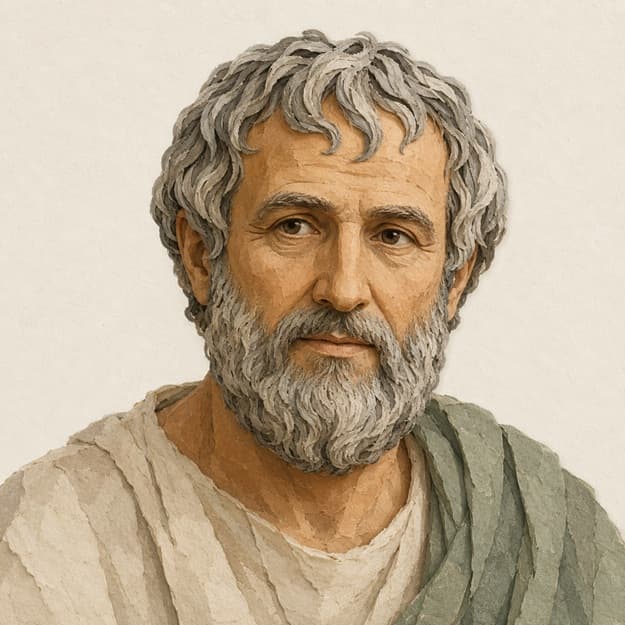
Questions hidden inside
- What does human flourishing involve across a whole life?
- How are virtues formed through practice rather than rule memorization?
- What distinguishes voluntary action, choice, ignorance, and compulsion?
- Why do friendship and external fortune matter to an otherwise virtuous life?
A practical inquiry into living well
Aristotle was a fourth-century BCE Greek philosopher whose surviving works investigate nature, reasoning, living beings, psychology, ethics, politics, and art. This profile focuses on the Nicomachean Ethics and does not attempt to summarize the entire corpus.
The ethical inquiry begins from human practices and judgments rather than from a promise of mathematical precision. Aristotle repeatedly warns that an account should seek the degree of exactness appropriate to its subject.
Flourishing as activity across a life
Aristotle's central term, eudaimonia, is often translated as happiness or flourishing. It does not mean a passing mood. It concerns living and acting well across a life through activities that express developed human capacities.
Pleasure, friendship, material conditions, political circumstances, and fortune all enter the account. Virtue is central, but Aristotle does not claim that character makes a person invulnerable to severe loss or deprivation.
Flourishing is an activity and pattern of life, not merely a feeling or possession.
Virtue requires judgment
Moral virtues are stable dispositions developed through habituation. The doctrine of the mean describes appropriate response between opposed errors, but it is not a rule requiring a moderate amount of every emotion or action.
Practical wisdom is the capacity to deliberate well about what should be done in particular circumstances. General principles matter, yet good judgment must attend to details, relationships, timing, motives, and the possibilities actually available.
| Idea | Plain-language role | Common misunderstanding |
|---|---|---|
| Virtue | A developed disposition to feel and act well | A fixed personality trait that guarantees correct action |
| Mean | The appropriate response relative to the circumstances | Always choosing the numerical middle |
| Practical wisdom | Sound deliberation about particulars | Mechanical application of a universal formula |
| Habituation | Formation through repeated practice and institutions | Unthinking conformity without reflection |
Choice, responsibility, and friendship
Aristotle distinguishes voluntary action from conduct produced by compulsion or certain forms of ignorance. His discussion connects responsibility with what the agent knew, how the action originated, and whether character itself has been shaped through earlier choices and practices.
Friendship is not an optional decoration in the ethical life. Aristotle examines relationships based on use, pleasure, and mutual appreciation of character, while also raising difficult questions about equality, dependence, exclusion, and the social conditions of flourishing.
- Do not treat virtue ethics as indifference to rules or consequences.
- Explain the mean through context and judgment rather than numerical moderation.
- Distinguish temporary good fortune from flourishing across a whole life.
- Recognize that Aristotle's account reflects ancient social assumptions that contemporary readers may reject.
Continue with Ada

Professor Ada Rowan
Test an idea or objection
Compare perspectives, test an assumption, or develop an objection using this reviewed page as context.
Related paths
Paths through the present
Recent reflections featuring this philosopher
Sources
- Aristotle: Nicomachean Ethics — Aristotle (2014)
Primary source for Aristotle's account of the human good as flourishing, the role of virtue and activity, voluntary action, choice, practical wisdom, responsibility, friendship, and the contribution of external fortune.
View source
Last modified 2026-07-31. Reviewed by Thinking Paths editorial team.