Questions hidden inside
- How do repeated practices and relationships contribute to moral character?
- What is the relationship between humane concern and ritual conduct?
- When should inherited forms guide action, and when should judgment adapt them?
- Can government rely on moral example without neglecting institutions, disagreement, and unequal power?
A teacher encountered through layered traditions
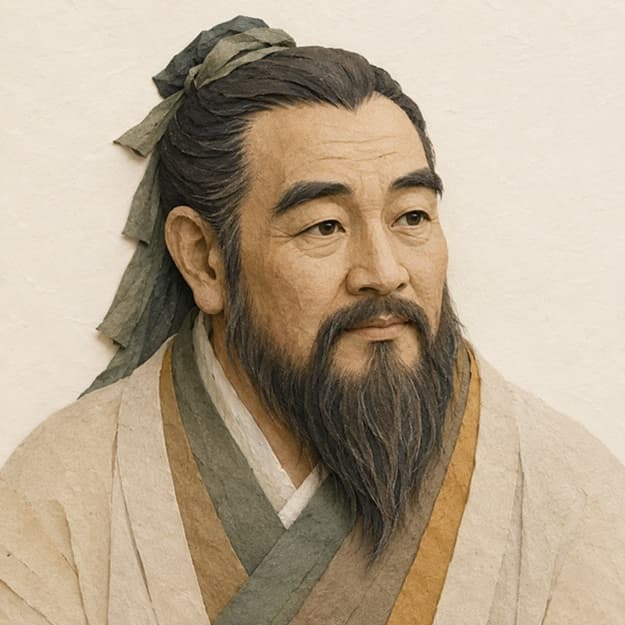
Confucius is the Latinized name for Kongzi, or Master Kong, traditionally dated from 551 to 479 BCE. Early sources portray him as a teacher, ritual specialist, advisor, official, and transmitter of inherited learning during a period of political fragmentation.
The Analects is a collection of brief dialogues and sayings associated with Confucius and his students, compiled and interpreted across time. It is the central source for this profile, but it does not offer one continuous argument or a secure transcript of every historical conversation. Later traditions also developed ideas that should not automatically be attributed to Confucius himself.
Humane concern and ritual practice
Two recurring terms are ren, often translated through ideas such as humaneness or authoritative conduct, and li, which includes rites, ceremonies, manners, and context-sensitive forms of respectful behavior. Neither English translation captures every use, so the terms should be understood through the relationships and examples in which they operate.
Ritual is more than empty conformity in the strongest Confucian interpretations. Practiced with attention and appropriate feeling, it can shape dispositions, communicate respect, and coordinate shared life. Yet the Analects also portrays judgment about when a form remains meaningful, raising a tension between faithful practice and rigid formalism.
Ritual can cultivate and express ethical attention, but correct form without humane concern is not enough.
Character grows through learning and practice
Confucius presents moral development as an ongoing activity of study, reflection, imitation, correction, and practice. The exemplary person is not merely someone who knows rules, but someone whose perception, emotion, speech, and conduct have become responsive to the demands of a situation.
This emphasis invites comparison with virtue ethics, especially Aristotle's account of habituation and practical wisdom. The comparison can clarify both traditions, but they should not be collapsed: Confucian cultivation gives distinctive weight to ritual, family roles, inherited texts, and the ethical texture of ordinary relationships.
| Term | Working explanation | Misleading reduction |
|---|---|---|
| Ren | Humane or authoritative conduct expressed across relationships | A private feeling of kindness alone |
| Li | Ritual and appropriate forms that cultivate and communicate respect | Blind obedience to every inherited custom |
| Yi | Judgment about what is fitting or right in a situation | One mechanical rule for every case |
| Junzi | An exemplary person formed through learning and ethical practice | A person made superior by birth or status alone |
Relationships, roles, and government by example
The Analects treats family, friendship, teaching, public service, and political leadership as important settings for moral formation. Roles carry differentiated responsibilities rather than assuming that every relationship has the same form. Ethical life is therefore deeply relational, but the tradition continues to debate how role-based care should relate to impartial justice.
Confucius often contrasts government through virtue, trust, and ethical example with rule that depends primarily on punishment. This ideal asks leaders to cultivate themselves and make good conduct credible. It also faces an objection: exemplary character may be insufficient when institutions distribute power unfairly or leaders and citizens disagree about the virtues being modeled.
A living legacy with internal disagreements
Teachings associated with Confucius shaped education, family ethics, public administration, and philosophical debate across East Asia, but there has never been only one unchanging Confucian position. Mencius, Xunzi, later commentators, critics, reformers, and modern philosophers developed sharply different accounts of human nature, ritual, hierarchy, gender, and political order.
A selective profile should neither treat Confucius as a symbol for all Chinese culture nor dismiss relational ethics as simple obedience. His work remains valuable partly because it asks how small repeated actions, forms of attention, and unequal roles can cultivate—or deform—the character of people who share a world.
- Treat traditional dates and biographical stories with appropriate caution.
- Distinguish Confucius from the full range of later Confucian traditions.
- Define key terms contextually rather than assuming one fixed English equivalent.
- Compare Confucian and Aristotelian virtue carefully without erasing their differences.
- Examine hierarchy, gender, partiality, and institutional power alongside the ideal of ethical relationships.
Continue with Ada

Professor Ada Rowan
Test an idea or objection
Compare perspectives, test an assumption, or develop an objection using this reviewed page as context.
Related paths
Paths through the present
Recent reflections featuring this philosopher
Sources
- Analects: With Selections from Traditional Commentaries — Confucius (2003)
A scholarly translation of the Analects accompanied by traditional commentaries, notes, appendices, and a glossary. It supports discussion of humane concern, ritual, appropriate judgment, learning, character cultivation, family relationships, and government by moral example while displaying interpretive plurality.
View source - Confucius (2020)
A scholarly overview of the changing historical representations of Confucius, early textual sources, ritual psychology, social values, virtues, character formation, family, and government. It foregrounds uncertainty about biography and the layered construction of Confucius as a philosophical figure.
View source - Chinese Ethics (2023)
A comparative scholarly survey of major Chinese ethical traditions, with detailed treatment of Confucian virtue, ritual, relational values, differentiated care, agency, gender, and political questions. It situates Confucius without treating Chinese philosophy as one homogeneous tradition.
View source
Last modified 2026-07-31. Reviewed by Thinking Paths editorial team.